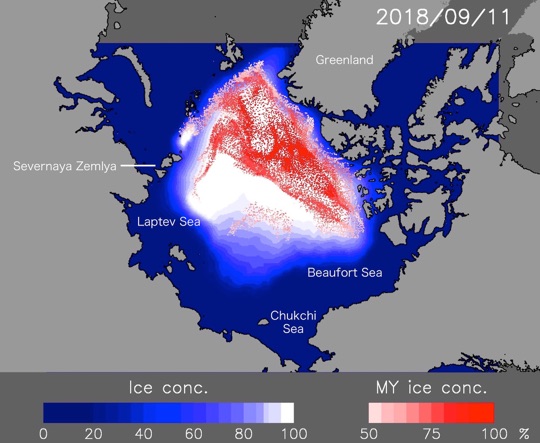
Most of the multi-year ice in the Arctic is distributed in Greenland-Canadian Archipelago side. It also spread toward Beaufort and Chukchi Seas and extends to the Laptev Sea and Severnaya Zemlya. This pattern will be maintained during this summer.
Analysis of multi-year ice distribution
Figure1:Predicted sea ice cover and multi-year ice distribution on September 11, 2018.
※Prediction map is also available in
of National Institute of Polar Research.
---------------
---------------



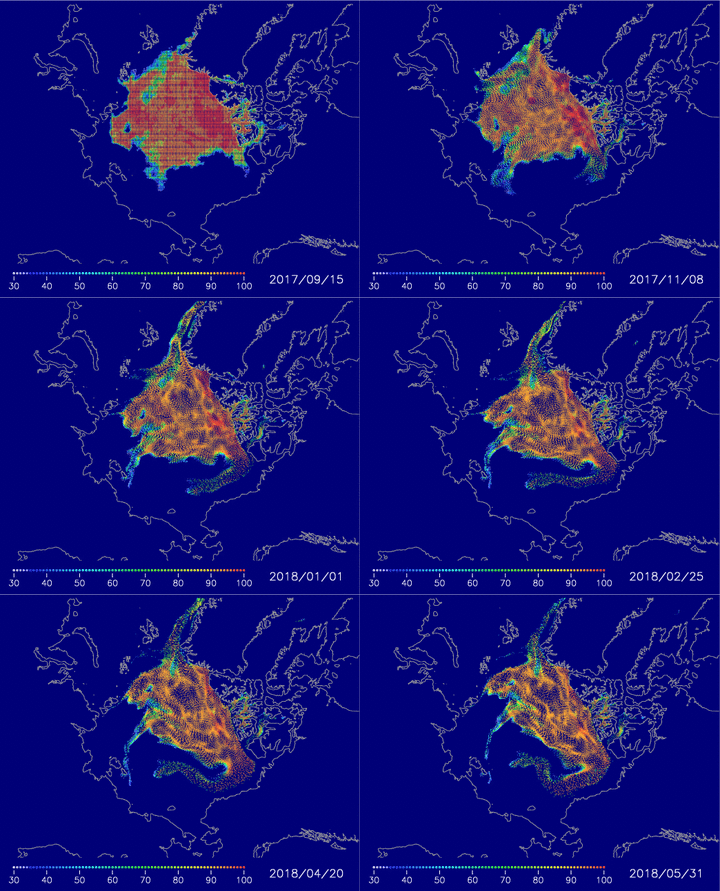
To detect the distribution of multi-year ice (MYI) in the Arctic, we tracked the sea ice from the September minimum to the next year using the daily sea ice motion derived from AMSR-E and AMSR2 data.
We found that the MYI distribution in summer is similar to that in the late spring (Figure 5, 6 and 7).
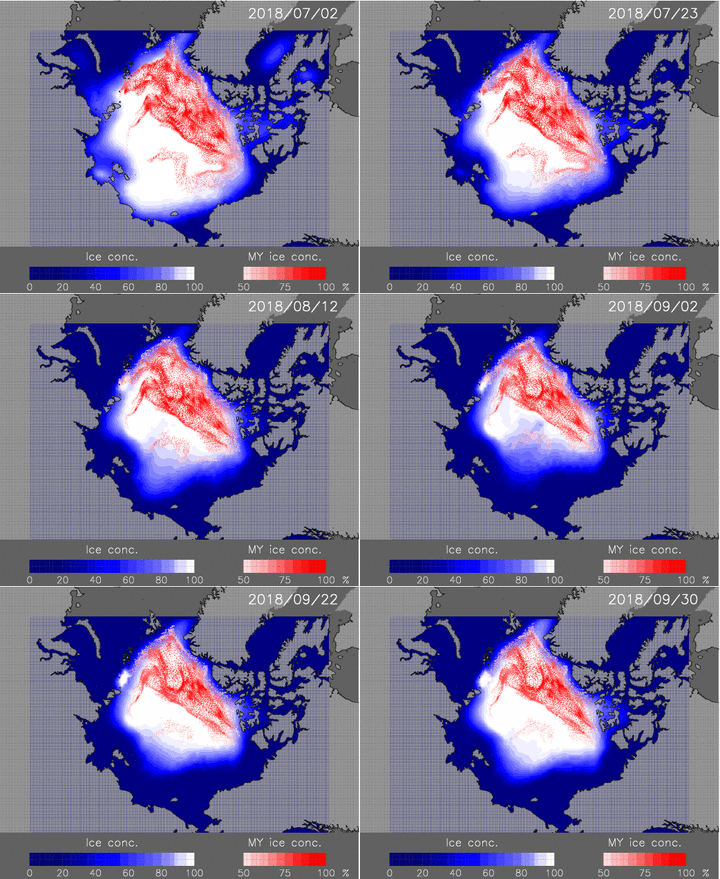
In this prediction, we first derived the MYI distribution on May 31 of this year by the tracking. Then, daily change of the MYI from June to September is estimated using mean ice motion for each day averaged over 2004-2017.
Figure 4:Animation of multi-year ice distribution from September 15, 2017 to May 31, 2018.
Figure 5:Multi-year ice distribution on May 31 and September 10, 2013
Arctic Sea Ice Forecast 2018
Third Report: Forecast of multi-year ice distribution
July 31, 2018
Noriaki Kimura, Hiroyasu Hasumi
Atmosphere and Ocean Research Institute, The university of Tokyo
Figure 2:Animation of predicted sea ice cover and multi-year ice distribution from the July 2 to the September 30. Red dot shows the multi-year ice.
Figure 3:Multi-year ice distribution on May 31, 2018, tracked from September 15, 2017 using the daily sea-ice motion data.
Figure 6:Multi-year ice distribution on May 31 and September 10, 2015
Figure 7:Multi-year ice distribution on May 31 and September 10, 2017
If you have any questions, please contact kimura_n@aori.u-tokyo.ac.jp
This work was supported by
Arctic Challenge for Sustainability Project.